
If you have been wondering whether Cognitive Behavioral Therapy is actually effective for anxiety — the short answer is yes, and it is one of the most well-researched psychological treatments in the world. Decades of clinical studies, large-scale reviews, and real-world outcomes across thousands of patients have consistently shown that CBT produces meaningful, lasting reduction in anxiety symptoms in around 60 to 80 percent of people who complete a full course. It works for generalised anxiety, social anxiety, panic disorder, health anxiety, and phobias. The reason it works so well is simple — instead of just talking about your worries, CBT gives you practical tools to change the way your brain reacts to anxious triggers in everyday life. This blog explains exactly how effective CBT is for anxiety, what the research really says, and what you can expect if you start CBT in Gurgaon.
This effectiveness is something that Rishika Vashishtha and Meenakshi Malik, two of Gurgaon’s most experienced Licensed Clinical Psychologists, see in their practice every week. Both are Co-Founders at their clinic, registered with the Rehabilitation Council of India, and bring over five years of clinical experience each in delivering evidence-based CBT for anxiety, depression, OCD, trauma, and self-esteem concerns.
What they often tell first-time clients is this — CBT does not magically remove anxious thoughts. It changes your relationship with those thoughts, teaches your nervous system that the feared outcome rarely happens, and slowly builds a life where anxiety stops calling the shots.

What the Research Actually Says About CBT for Anxiety
Cognitive Behavioral Therapy is not just popular — it is the most rigorously studied form of psychotherapy in modern history. According to the American Psychological Association, the UK’s NHS, and the World Health Organization, CBT is recommended as the first-line psychological treatment for almost every type of anxiety disorder.
Here is what large-scale clinical reviews have consistently found:
- Around 60 to 80 percent of people with anxiety disorders show significant improvement after a full course of CBT.
- For panic disorder, CBT is shown to be as effective as medication — and the benefits last longer after treatment ends.
- For social anxiety, CBT often outperforms medication alone in long-term outcomes.
- For generalised anxiety, structured CBT typically produces results in 12 to 20 sessions.
- Relapse rates are significantly lower with CBT compared to medication alone, because the skills stay with you for life.
These numbers are why every major mental health body in 2026 still ranks CBT as the gold-standard first-line treatment for anxiety.
Why CBT Works So Well for Anxiety
Anxiety is not just “worrying too much.” It is your nervous system stuck in a loop of perceived danger. Your thoughts spiral, your body tenses, your sleep breaks, and you start avoiding the very situations that could help you feel better. CBT interrupts this loop from two angles at once — the thinking side and the behaviour side.
On the thinking side, CBT teaches you to identify what therapists call automatic negative thoughts. These are the silent assumptions that fire off in your mind before you even notice — “I’m going to embarrass myself,” “Something bad is about to happen,” “I can’t handle this.” CBT slows these thoughts down, examines the evidence behind them, and helps you reframe them in a way that is realistic rather than catastrophic.
On the behaviour side, anxiety often makes us avoid things — meetings, social events, driving, even calling the doctor. The more we avoid, the bigger the fear grows. CBT uses gentle, gradual exposure to help you face these situations in small, manageable steps, so your brain slowly learns that the feared outcome rarely arrives.
This double-action — changing thoughts and behaviours together — is exactly why CBT outperforms therapies that only do one or the other.
What a CBT Session in Gurgaon Actually Looks Like
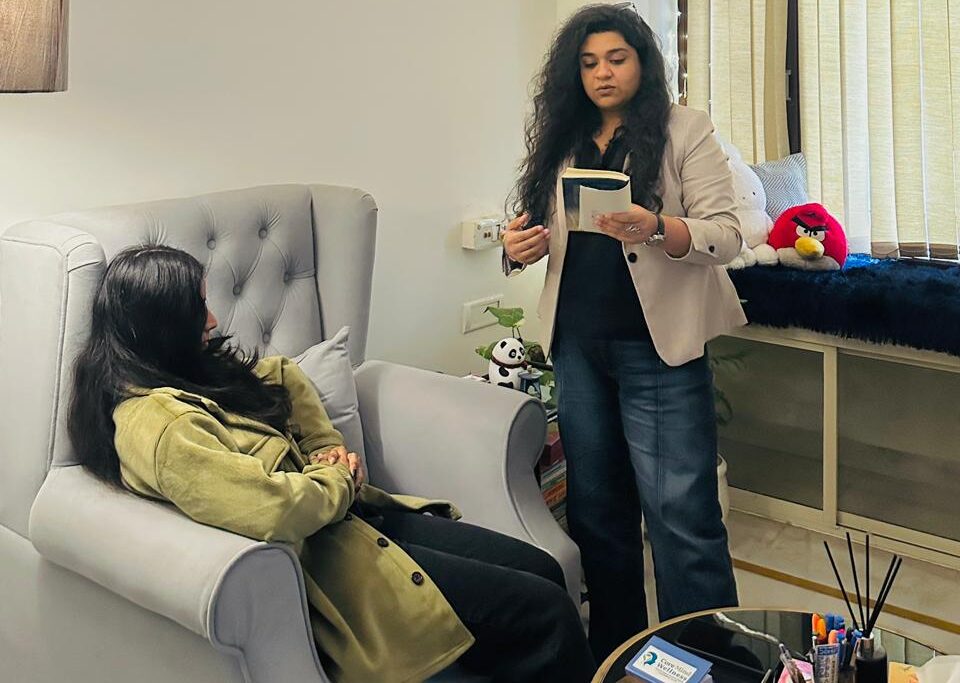
A common reason people delay therapy is that they imagine it will be uncomfortable or overwhelming. In reality, expert CBT in Gurgaon delivered by a trained clinical psychologist looks far calmer than most people expect.
A typical CBT journey for anxiety unfolds like this:
- Session 1 — Assessment and goal setting: Your psychologist listens to your story, maps your anxiety triggers, and explains how CBT will work for your specific concern.
- Sessions 2 to 4 — Building awareness: You learn to identify anxious thoughts, physical sensations, and avoidance patterns.
- Sessions 5 to 10 — Skills building: You practise cognitive restructuring, breathing techniques, behavioural experiments, and gradual exposures.
- Sessions 11 to 16 — Generalisation: You take the new skills into real life — meetings, travel, social events, daily stressors.
- Final sessions — Relapse prevention: You build a personal toolkit so you can manage future anxiety on your own.
The whole structure is designed to be practical, transparent, and time-limited — not endless.
A Realistic Example
Consider a hypothetical case — Aman, a 30-year-old IT manager from Sector 49, started experiencing panic attacks before every client presentation. He avoided meetings, started skipping work, and his confidence began to crumble. After his first three CBT sessions, he could already identify the thought spirals that triggered his panic. By session eight, he had learned breathing techniques and small exposure tasks. By session fourteen, he was leading presentations again — not because the anxiety completely disappeared, but because it no longer ran the show. That is the realistic arc of well-delivered CBT for anxiety.
Why You Need a Trained CBT Therapist, Not Just a Counsellor
CBT looks simple on paper but is genuinely difficult to deliver well. Done by an untrained counsellor, CBT can become vague advice. Done by a properly trained clinical psychologist following a structured protocol, it becomes one of the most powerful interventions in mental health.
This is why looking for the best CBT therapist near me matters. A good CBT therapist must be:
- RCI-licensed as a clinical psychologist
- Specifically trained in CBT protocols for anxiety
- Experienced in tailoring CBT to different anxiety types
- Comfortable integrating CBT with other evidence-based therapies like ACT, ERP, or Mindfulness-Based Therapy when needed
At Core Mind Wellness in Gurgaon, Rishika Vashishtha and Meenakshi Malik deliver CBT using current, research-supported protocols rather than older or generic versions. Both work in-clinic and online, with adults, adolescents, and children — making them among the most trusted best Cognitive Behavioral Therapy doctors in Gurgaon for anxiety treatment.
So — Is CBT Worth It for Anxiety?
The honest answer, backed by 40 years of research and thousands of real-world clinical outcomes — yes, CBT is worth it, and for most people with anxiety, it is the single most effective psychological treatment available. The benefits last well beyond the sessions, the skills become part of who you are, and most clients say their only regret is not starting sooner.
📞 Call or WhatsApp: +91 9319136642 📧 Email:
📍 Visit: H. No. 159, 1st Floor, Sector-28, Gurugram, Haryana-122002
Your first session is a calm conversation. No pressure, no exposures, no homework — just a space to be heard and to begin.
Frequently Asked Questions (FAQs)
Q1. How effective is Cognitive Behavioral Therapy for anxiety?
Clinical research shows that 60 to 80 percent of people with anxiety disorders experience significant improvement after a full course of CBT. It is recognised as the first-line psychological treatment for anxiety by the APA, NHS, and WHO.
Q2. How many CBT sessions are needed for anxiety?
Most clients see meaningful improvement within 12 to 20 sessions, usually spread over three to five months. Milder anxiety can respond in fewer sessions; complex cases may need longer.
Q3. Is CBT better than medication for anxiety?
For many anxiety disorders, CBT is as effective as medication and produces longer-lasting results. For moderate to severe anxiety, a combination of CBT and medication often gives the strongest outcomes. Your psychologist can refer you to a consultant psychiatrist if medication is needed.
Q4. Can Cognitive Behavioral Therapy in Gurgaon be done online?
Yes. Online CBT is just as effective as in-person CBT for most anxiety conditions. Both Rishika Vashishtha and Meenakshi Malik offer secure online sessions for clients across Gurgaon and India.
Q5. How do I find the best CBT therapist in Gurgaon?
Look for an RCI-licensed clinical psychologist with specific training in CBT protocols, not just general counselling. You can reach the team by calling or WhatsApp on +91 93191 36642 or emailing peace@coremind-wellness.com.
Q6. Does CBT really work long-term for anxiety?
Yes. One of CBT’s biggest strengths is its long-term effectiveness. Because it teaches you transferable skills, the benefits often last well beyond the end of therapy — making relapse rates significantly lower than with medication alone.