
If you have spent years trying to manage your OCD with talk therapy, willpower, motivational quotes, or even medication alone — and nothing has truly worked — there is a reason for that. The only psychological treatment with strong, repeated scientific proof to actually treat Obsessive-Compulsive Disorder is Exposure and Response Prevention (ERP) Therapy for OCD, and yes, it is available in Gurgaon through licensed clinical psychologists. ERP does not try to talk you out of your fears or simply make you feel better in the moment. It rewires the loop at the root — by helping you face the trigger and not perform the compulsion, your brain finally learns that the danger was never real. This blog explains why ERP works when other therapies don’t, what actually happens during treatment, and how to find the right OCD psychologist in Gurgaon to guide you through it.
Why Most Therapies Fail at Treating OCD
Here is something most people don’t realise — general counselling, regular talk therapy, motivational coaching, and even some forms of CBT do not work well for OCD. In fact, the wrong kind of therapy can make OCD worse. Why? Because talking about your obsessions repeatedly, getting reassurance from a therapist, or analysing where your fears “came from” actually feeds the loop. Every reassurance, every long discussion about whether the door was really locked, every gentle “don’t worry, you’re fine” — your brain logs it as proof that the obsession was important.
This is the painful trap many people in Gurgaon fall into. They visit counsellor after counsellor, spend lakhs over years, and feel exactly the same — or worse. Not because they aren’t trying. Not because therapy doesn’t work. But because they were never given the right therapy.
The right therapy has a name, and it has been proven in clinical research for over four decades.

What Is Exposure and Response Prevention (ERP) Therapy for OCD?
Exposure and Response Prevention (ERP) Therapy is a specialised form of Cognitive Behavioral Therapy designed only for OCD and a few closely related conditions. It has two parts working together.
Exposure means deliberately and gradually facing the thoughts, images, situations, or sensations that trigger your obsessions — with full support from your therapist, never thrown at you suddenly.
Response Prevention means choosing not to perform the compulsion that normally follows. If you usually wash your hands for ten minutes after touching a door, response prevention means sitting with the discomfort instead — under expert guidance, in small steps that match your readiness.
Together, these two elements break the cycle that talking alone cannot touch. According to the International OCD Foundation, the American Psychiatric Association, and the UK’s NHS, ERP is the first-line psychological treatment for OCD. Research consistently shows that around 70% of people who complete ERP experience significant, lasting reduction in OCD symptoms — a number no other psychological treatment for OCD has ever matched.
The Indian Journal of Psychiatry has also recognised ERP as the gold-standard treatment in the Indian clinical context. This is not opinion. This is decades of clinical data across thousands of patients worldwide.
Why You Need a Specialist for ERP, Not Just a Counsellor
ERP looks straightforward on paper but is genuinely difficult to deliver correctly. Done by an untrained counsellor — or even by a well-meaning therapist without OCD-specific training — exposures can be poorly designed, response prevention can be incomplete, and OCD can actually worsen. This is why a psychologist in Gurgaon for ERP Therapy for OCD must be specifically trained in OCD protocols, not just general counselling.
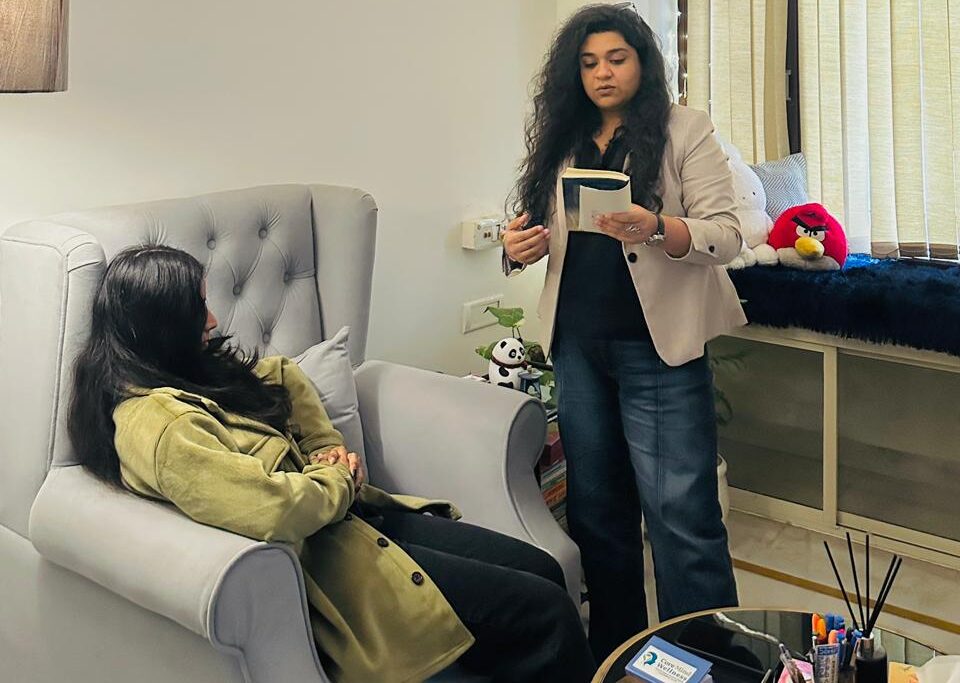
At Core Mind Wellness in Gurgaon, the practice is led by two Co-Founders who are Licensed Clinical Psychologists (A) registered with the Rehabilitation Council of India and formally trained in Exposure and Response Prevention.
Rishika Vashishtha is a Co-Founder and Licensed Clinical Psychologist (A) with over five years of clinical experience treating OCD, anxiety, intrusive thoughts, phobias, and trauma. Her practice is built on evidence-based protocols including ERP, CBT, ACT, and Mindfulness-Based Therapy. She is currently pursuing her Ph.D. in Clinical Psychology and works extensively with adults, adolescents, and children.
Meenakshi Malik is also a Co-Founder and Licensed Clinical Psychologist (A) with five-plus years of clinical experience in evidence-based psychotherapy, psychodiagnostics, and psychometric assessment. She specialises in OCD, anxiety, trauma, ADHD, and personality concerns, and is also pursuing her Ph.D. in Clinical Psychology. Both clinicians use current, research-supported ERP protocols rather than outdated or generic approaches — which is precisely why they are trusted as among the best OCD psychologists in the city.
A Realistic Example of ERP in Action
Consider a hypothetical case — Karan, a 31-year-old finance professional from Sector 56, had been silently battling checking OCD for nine years. He would lock his front door, walk away, then return five or six times to check again. Some mornings he was late for work. Some nights he barely slept. After two years of regular counselling that didn’t help, he started ERP. His exposure hierarchy began with leaving the door locked and walking to his car without returning to check, even though his anxiety screamed at him. Two weeks later, he could leave for work in a single attempt. By month three, he was travelling overnight without spiralling. His OCD did not vanish — but it stopped running his life. That is what successful ERP looks like. Not magic. Just science, delivered properly.
Who Should Consider ERP Therapy
ERP is the proven treatment for a wide range of OCD presentations and related conditions, including:
- Contamination and washing OCD
- Checking compulsions — locks, gas, appliances, mistakes
- Intrusive harm or violent thoughts
- Unwanted sexual intrusive thoughts
- Religious or moral scrupulosity
- Relationship OCD and “is this the right person” doubts
- Symmetry, ordering, and “just right” compulsions
- Health anxiety and reassurance-seeking
- Specific phobias
If even one of these matches your experience, ERP is very likely the treatment your brain has been waiting for.
Take the First Step Toward Real Recovery
OCD is not a character flaw. It is not weakness. It is not something you can “just stop.” It is a treatable medical condition — and ERP is the treatment with the strongest evidence behind it. If you have been carrying this silently for years, this is your sign to stop suffering in silence.
The team at Core Mind Wellness in Sector 28, Gurugram, offers ERP Therapy for OCD both in-clinic and online, with full confidentiality and zero judgement.
📞 Call or WhatsApp: +91 9319136642 📧 Email:
📍 Visit: H. No. 159, 1st Floor, Sector-28, Gurugram, Haryana-122002
Your first session will not involve any exposures. It will simply be a calm conversation where your therapist listens, understands your OCD, and explains the road ahead clearly.
You have spent enough years inside the loop. Recovery is closer than you think.
Frequently Asked Questions (FAQs)
Q1. Why is ERP considered the only therapy that works for OCD?
ERP is the only psychological treatment for OCD with strong, repeated clinical proof across decades and across countries. The International OCD Foundation, the American Psychiatric Association, the NHS, and the Indian Journal of Psychiatry all recognise ERP as the first-line treatment because it directly breaks the obsession-compulsion cycle rather than just discussing it.
Q2. How long does ERP Therapy for OCD in Gurgaon take?
Most clients complete active ERP in 14 to 20 sessions, typically spread over three to five months. Mild OCD can improve faster; complex or severe cases may need longer. Your psychologist will discuss a realistic plan during your first session.
Q3. Is ERP painful or frightening?
ERP is challenging but never traumatic. Exposures are always built collaboratively, starting at the easiest level. You are never forced into anything you are not ready for. Most clients say the anticipation is harder than the actual exposure itself.
Q4. Do I need medication along with ERP?
Not always. Many people respond very well to ERP alone. For moderate to severe OCD, a combination of ERP and an SSRI prescribed by a psychiatrist often produces the strongest results. Your therapist will refer you to a consultant psychiatrist if needed.
Q5. Can ERP be done online for OCD patients in Gurgaon?
Yes. Online ERP is just as effective as in-person ERP for most OCD types, especially because many exposures need to happen at home anyway — for contamination, checking, or reassurance-seeking compulsions. Both clinical psychologists offer secure online sessions.
Q6. How do I find the best psychologist for treatment of OCD in Gurgaon?
Look for an RCI-licensed clinical psychologist with specific training in ERP, not just general counselling. You can reach Rishika Vashishtha or Meenakshi Malik by calling or WhatsApp on +91 93191 36642 or emailing peace@coremind-wellness.com. The team will help you choose the right fit based on your specific OCD pattern.